That’s a gap of about 16.4 points across 50 queries, over the 15-point line for a Confirmed grade. Page-one pages were roughly three times more likely to show up in Perplexity’s sources.
The catch: two out of three sources Perplexity listed weren’t in Google’s top 30 at all.
The claim
If you work in SEO, you’ve probably heard this one. Rank well on Google, and the AI citations will follow. It comes up in vendor blogs, LinkedIn threads, and almost every “AEO is just SEO” argument.
The logic is simple. AI search tools look things up on the web before they answer. So the pages that already rank well should be the ones they pick.
If that’s true, your SEO work carries straight over to AI search. If it isn’t, a lot of people are working on the wrong thing.
The hypothesis
Pages that rank on Google’s first page are listed as sources by Perplexity more often than pages that rank lower.
How I tested it
I selected 50 SaaS search queries, 25 informational and 25 commercial and ran every query on Perplexity by hand, in a fresh incognito window each time. On the same day, I pulled Google’s top 30 results for the same 50 queries (so changes in Google’s rankings over time don’t affect the comparison), then I checked every Perplexity source against those results and sorted it into one of these three groups:
- Group A: on Google’s first page (positions 1–10)
- Group B: on Google’s second or third page (positions 11–30)
- Group C: not in Google’s top 30
What happened?
Group A vs. Group B
Across 50 queries, Google ranked 494 pages on its first page and 946 pages in positions 11 to 30. Here’s how many of each Perplexity listed as a source:
| Group | Pages Google ranked | Listed by Perplexity | Rate |
| A: First page (1-10) | 494 | 121 | 24.5% |
| B: Positions 11 -30 | 946 | 77 | 8.1% |
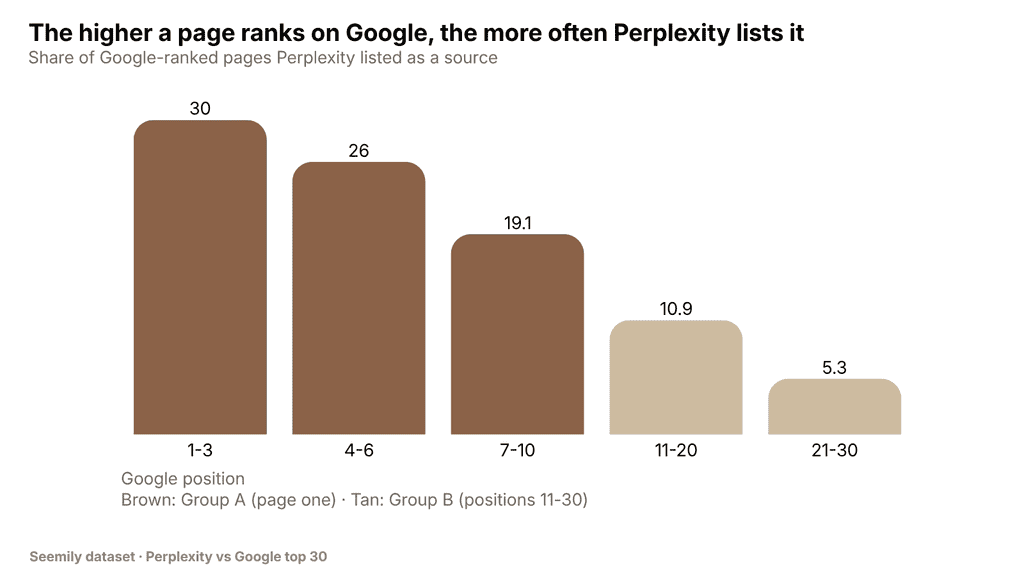
There’s no cliff after page one. The odds fall step by step, a page in the top three was listed more than five times as often as a page ranking 21 to 30.
The twist: most sources weren’t in Google’s top 30
So page one helps. But when I looked at where Perplexity’s sources actually came from, Google’s first page was only a small part of the story.
| Group | Sources Perplexity listed | Share |
| A: First page | 121 | 21% |
| B: Positions 11–30 | 77 | 13% |
| C: Not in Google’s top 30 | 383 | 66% |
Two out of three sources came from Group C. Even counting by brand instead of exact page, so that a brand counts if any of its pages ranked, half of Perplexity’s sources came from brands that weren’t in Google’s top 30 for that query.
These weren’t obscure sites. Salesforce, Forbes, HubSpot, Zoho, Capterra, G2, Notion and Bitwarden all turned up in Group C again and again. When I looked closer:
- About 3 in 10 were from a brand that did rank on Google, just with a different page.
- About 1 in 8 was regional copies of a page, like a UK or Australian version.
- The rest, about 6 in 10, came from brands that weren’t in Google’s top 30 for that query at all.
One query that shows this clearly is “best HR software for startups”, Perplexity listed 21 sources. None were on Google’s first page. Eighteen weren’t in the top 30. Google’s first page had BambooHR, Zapier, Zoho, G2 and YouTube, and Perplexity listed none of them.
What Perplexity’s sources had in common
Ranking is one piece. To see what else stood out, I sorted every source by the kind of site it came from and the kind of page it was.
Editorial and review sites were picked far more often. Among pages Google ranked in its top 30:
| Kind of site | Listed by Perplexity |
| Publishers (Forbes, PCMag, TechRadar) | 42% |
| Review and comparison sites (G2, Capterra) | 35% |
| Company and vendor sites | 13% |
| Forums (Reddit, Quora) | 6% |
| YouTube | 2% |
When I looked at all the factors together, being a publisher or review site mattered about as much as ranking on page one. Each made a page roughly four times more likely to be listed. Forum and YouTube pages were listed less often, even when Google ranked them well, though there were too few of them to say by how much.
Pages written to answer one specific question did better than general articles. “X vs Y” pages, glossaries, “best of” lists and “alternatives” pages were listed about 1.8 times as often as general-topic articles (opinion pieces, news, broad advice) with the same Google position. Having the search words in the page address made no clear difference once these were accounted for.
The type of question changed the mix. For “what is” questions, 90% of sources were company sites explaining their own field. For “best” and “vs” questions, about two-thirds were “best of” lists (34%) and comparison pages (31%).
Named brands showed up for their own comparisons. In “X vs Y” queries, the brands in the question took nearly half of the source slots like 6 of 10 for “slack vs Microsoft teams”, and 20 of 25 for “1password vs bitwarden”.
A few sites appeared everywhere. Forbes and Salesforce were each listed for 15 of the 50 queries, and Zapier for 12. In about one answer in four, a single site took three or more of the source slots.
What this doesn’t prove
This grade means associated with never causes. Perplexity may pick page one pages for the same reasons Google ranks them, like trust, depth or brand strength, not because it follows Google.
Specific to this test:
- One engine. ChatGPT, Gemini or Google’s AI Overviews may behave differently.
- One niche, one country. 50 SaaS queries, other topics and markets may not match.
- Top 30 only. A page in Group C may still rank at position 40 or 80. “Not in the top 30” doesn’t mean “not on Google”.
- Exact-page matching. A regional copy of a ranking page counts as a different page, which pushes some sources into Group C. Counting by brand narrows the gap, but doesn’t close it.
- No page content. I only did analysis of web addresses. Structure, freshness, schema and author details weren’t checked, so I can’t say whether they matter.
What this means for you
Your SEO work isn’t wasted. A page on Google’s first page was about three times more likely to be picked up by Perplexity than one on pages two or three, and the higher it ranked, the better its odds.
But ranking isn’t the whole door. Most of Perplexity’s sources came from outside Google’s top 30, and the ones that did well had something else in common. They were editorial or review pages, or comparisons and informational, not ordinary blog posts.
What I’d test next
The biggest open question is Group C. Why does Perplexity pick so many pages Google doesn’t rank highly? Is it searching related versions of the question, using its own index, or rewarding something on the page itself, like structure or freshness?
That’s the next experiment. I also want to run this same test on Google’s own AI Overviews, to see whether Google’s AI sticks closer to Google’s rankings than Perplexity does.
The data
It includes every query, source, Google position and every grouping.

Get the Next Result Before Anyone Else
Twice a month I take one AEO claim and test it against a real sample of citations. You get the result and the dataset, straight to your inbox.
One email per experiment. No spam, unsubscribe anytime.