I asked Perplexity “best email marketing software” on the 5th of October. The first source it listed was Shopify.
A few hours later, I asked again. This time, it was Sequenzy.
The next day, it was ZDNet. A week later, Forbes.
Same question, same laptop, same browser, four different top sources.
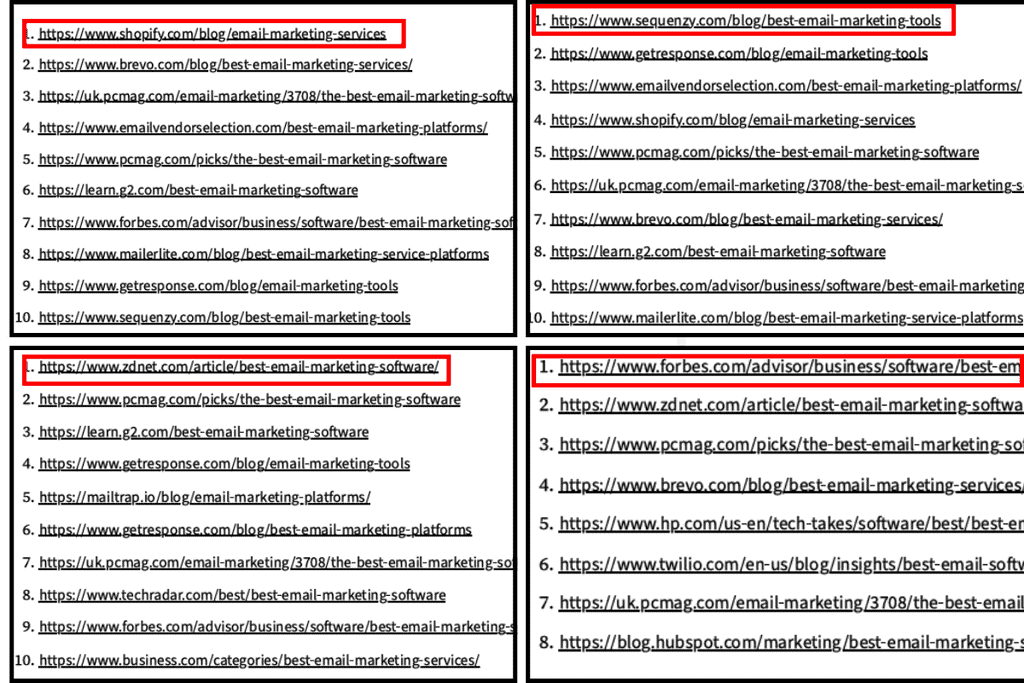
That’s the first thing to understand about Perplexity SEO. The sources it chooses change from search to search, so a citation you win today may be gone by next week.
Here’s the bigger picture.
I ran 50 SaaS queries through Perplexity four times each and logged all 2,108 sources it listed. In my final run, two thirds of the sources Perplexity listed weren’t in Google’s top 30 for the same query. Across all four runs, Perplexity listed about 10 sources per answer but cited only about 4 in the text. And only 28% of queries had the same top source a week later.
This guide shows you how Perplexity chooses its sources, seven steps that improve your odds of being cited, and how to track whether they’re working.
The short answer. Perplexity SEO is the practice of getting your pages found, trusted and cited in Perplexity’s answers. To get cited by Perplexity:
- Let PerplexityBot reach your site
- Publish the page type Perplexity already lists for your query
- Rank for that query on Google
- Put a direct answer at the top of the page
- Back your claims with named, dated sources
- Keep the page fresh and show the date
- Get mentioned on the sites Perplexity pulls from
Want to see the next Perplexity experiment before anyone else?
Seemily tests popular AEO claims against real data and publishes every result with its full dataset.
One email per experiment. No spam, unsubscribe anytime.
What is Perplexity SEO?
Perplexity SEO is the practice of getting your pages found, trusted and cited in Perplexity’s answers. It’s sometimes grouped under generative engine optimization (GEO) or answer engine optimization (AEO).
Perplexity is an answer engine. When you ask it a question, it searches the web in real time, reads the results and writes an answer with numbered citations. So the goal of Perplexity SEO is to be one of the four or five sources it names in the answer.
GEO and AEO cover optimizing for AI answers in general, across tools like ChatGPT and Google’s AI Overviews. Perplexity SEO is the same idea, aimed at Perplexity alone. At the simple end, you let its crawler read your site. At the complex end, you get other sites to talk about you.
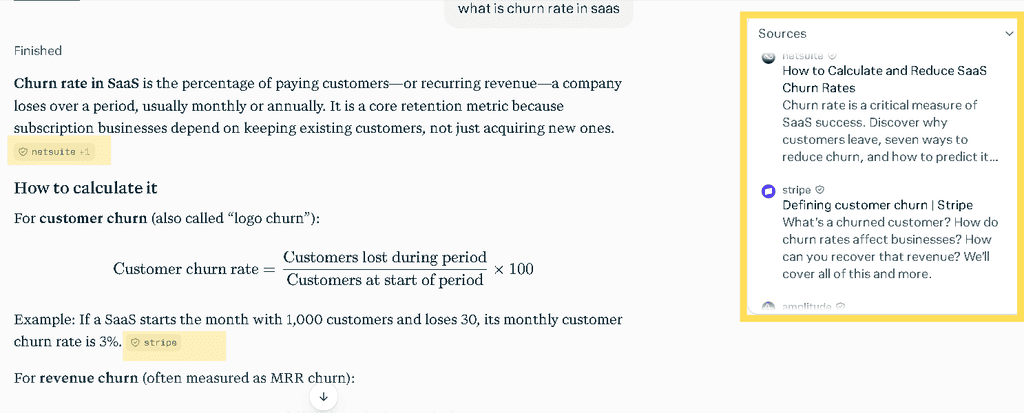
Every Perplexity answer has two parts. There’s a written answer with numbered citations in the text, and a list of sources behind it. Perplexity SEO is about showing up in both.
Perplexity SEO vs Traditional SEO
| Traditional SEO (Google) | Perplexity SEO | |
| What you compete for | A position in the search results | A place in Perplexity’s source list, and a citation in the answer |
| Crawler to allow | Googlebot | PerplexityBot (and Perplexity-User for live fetches) |
| What you track | Rankings, impressions and clicks | Whether you’re listed, whether you’re cited, and who is cited instead |
The two overlap, as the data below shows. But they aren’t the same job.
Is Perplexity SEO worth your time?
Perplexity SEO is worth your time as a small, low-cost channel. It isn’t a replacement for Google.
Let’s start with the size. Perplexity’s CEO, Aravind Srinivas, said at Bloomberg Tech Summit in June 2025 that Perplexity had handled 780 million queries in May, with growth above 20% month over month at the time. But Similarweb put Perplexity at 0.9% of generative AI website traffic in August and September 2026, down from 2.5% in October 2025. And Statcounter’s AI chatbot share for Perplexity was 5.85% worldwide in September 2026, down from 7.73% in April 2026.
Even so, the visitors it sends may be worth more. Across AI search overall, Semrush’s 2025 study found that the average AI search visitor is worth 4.4 times as much as the average organic search visitor, based on conversion rate.
So treat Perplexity as a small, volatile channel. Start with the cheap steps (crawler access, answer blocks and sourced claims), and invest more once you see citations and referral visits.
How does Perplexity choose its sources?
So how does Perplexity choose the sources for an answer? It doesn’t publish that, but every answer shows which sources it pulled from, so during my tests I compared them.
The short answer. In my tests, Perplexity listed about 10 sources per answer and cited fewer than half of them, mostly from the top of its list. Google rankings improved a page’s odds of being listed but didn’t decide it, and the picks changed from run to run.
Experiment 001 tracked which sources Perplexity listed and cited from run to run. Experiment 002 compared my final run with Google’s top 30. It’s a small sample from one niche. So use it to spot patterns, then test your own queries. The full method is on my methodology page.
Perplexity shows you two sets of sources, so I tracked them separately.
- Listed sources are the pages that appear in Perplexity’s source list
- Cited sources are the listed pages that the answer text points to with a numbered marker
Finding 1: Google rankings help, but they don’t decide it
If you’ve done SEO before, your first guess is probably that Perplexity chooses the pages Google ranks highest. It’s a fair guess. The two do overlap, and other studies have measured how much.
Ahrefs found that 28.6% of Perplexity’s cited URLs rank in Google’s top 10, the highest share among the AI assistants it tested and BrightEdge’s analysis put the overlap at 60%. The two studies measured different things, which explains the gap.
My tests found it too. In Experiment 002, I compared the sources Perplexity listed in my final run (12 October) with Google’s top 30 results from the same day. Pages on Google’s first page were about 3 times as likely to be listed (24.5%, against 8.1% for positions 11 to 30).
| Google position | Pages checked | Listed by Perplexity |
| 1 to 3 | 150 | 30% |
| 4 to 6 | 150 | 26% |
| 7 to 10 | 194 | 19% |
| 11 to 20 | 475 | 11% |
| 21 to 30 | 471 | 5% |
However, Google’s rankings explain only part of what Perplexity lists. 66% of the sources Perplexity listed weren’t in Google’s top 30 at all. Counting by brand instead of exact page, about half still came from brands outside the top 30.
So Google rankings improve your odds of making Perplexity’s list, but they don’t decide who makes it. (Example #1 below shows how far apart the two can be.)
Finding 2: Perplexity cites fewer than half of the sources it lists
Making the list is only the first step. Across my 200 answers, Perplexity listed 10.5 sources on average and cited 4.2 of them in the answer text.
| Measure | Result |
| Average sources listed per answer | 10.5 |
| Average sources cited in the answer text | 4.2 |
In other words, Perplexity lists about 10 pages and cites fewer than half of them. These citations also aren’t spread evenly across the list, sources 1 and 2 were cited 98% of the time.
| Position in source list | Cited in the answer text (200 answers) |
| Sources 1 and 2 | 98% |
| Sources 3 to 5 | 51% |
| Sources 6 to 10 | 14% |
| Source 11 and beyond | 0% |
By sources 6 to 10, that fell to 14%, and for any source past 10, Perplexity cited nothing. So being listed isn’t the goal. Being listed near the top is. If you want a citation, those first two or three slots is where to aim.
Finding 3: The sources change from run to run
Ask Perplexity the same question twice and you won’t always get the same sources. To measure how much they change, I compared each query’s later runs with its first run. Run 2 came a few hours later, Run 3 the next day and Run 4 a week later.
| Compared with Run 1 | A few hours later | Next day | A week later |
| Listed sources in common | 88% | 49% | 32% |
| Cited sources in common | 46% | 29% | 22% |
| Same top source | 46% | 28% | 28% |
A few hours later, 88% of the listed sources were the same, but only 46% of the cited ones were. So the list holds steadier than the citations. After a week, those dropped to 32% and 22%.
Even the first source in the list didn’t hold. Only 7 of 50 queries had the same top source in all four runs, as the email marketing example at the top of this post shows. So a citation you win today may be gone next week.
What this means for your SEO
Getting chosen isn’t one job. It’s three, and each one has its own fix. Here’s how I group the seven steps below.
- Getting listed. Perplexity has to reach your page, find it relevant, and see a page type it already uses (Steps 1, 2, 3 and 7)
- Getting cited. Your answer block, your evidence and your author details do that work (Steps 4, and 5)
- Staying cited. The sources change from run to run, so you have to keep checking and refreshing (Step 6, plus the tracking routine at the end)
The jobs also build on each other. A page Perplexity can’t reach can’t be listed, and a page that isn’t listed can’t be cited.
How do you get cited by Perplexity?
To get cited by Perplexity, let PerplexityBot reach your site, publish the page type Perplexity already lists for your query, rank for that query on Google, put a direct answer at the top of the page, back your claims with named and dated sources, keep the page fresh, and get mentioned on the sites Perplexity pulls from.
Below I’ll discuss the step-by-step process. To keep it concrete, I’ll use one query all the way through which is “what is churn rate in saas.” It’s one of the 50 in my tests. So, let’s say you run a SaaS analytics blog and you want to be the source Perplexity names for it.
Step 1: Let PerplexityBot reach your site
The first step is making sure Perplexity’s crawler can read your pages.
Perplexity says PerplexityBot is built to surface and link websites in its search results, and that it isn’t used to crawl content for AI model training. Its crawler documentation recommends allowing it in robots.txt and permitting requests from its published IP ranges.
A common concern is that allowing an AI crawler means your content will be used to train AI models. But according to Perplexity’s documentation, PerplexityBot isn’t used for that.
So you need to check three layers.
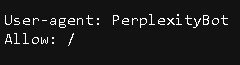
Layer 1: robots.txt. Open yourdomain.com/robots.txt and look for PerplexityBot. If you see this, you’re blocked.

Swap it for this:
Layer 2: Your firewall. A rule here can block PerplexityBot even when robots.txt allows it. If you use Cloudflare, Perplexity’s docs suggest this setup.
- In Cloudflare, go to Security, then WAF, then Custom rules
- Create a rule where User Agent contains PerplexityBot (or Perplexity-User) and IP Source Address is in the ranges published at perplexity.com/perplexitybot.json
- Set the action to Allow
Layer 3: Your server logs. Changes can take up to 24 hours to show. After that, check that the bot is actually visiting.
If nothing shows up a few weeks after you publish, go back to Layer 2.
There’s also a second agent called Perplexity-User, which fetches a page when a person’s question calls for it. According to the docs, this agent generally ignores robots.txt because a person requested the fetch, and it isn’t used for crawling or training.
So this means a robots.txt block won’t reliably keep a page away from someone who asks Perplexity about it directly.
Step 2: Find out which page type Perplexity already lists
Perplexity doesn’t use the same kind of page for every question. By page type, I mean the format of the page, such as a glossary entry, a company guide, a review site or a publisher article, rather than its topic. In my data, the type of question changed who filled the source slots.
| Query type | Example | Who filled the listed sources |
| “What is” | what is churn rate in saas | Company sites explaining their own field took 90% |
| “Best of” | best email marketing software | Company sites 66%, review sites 16%, publishers 16% |
| “X vs Y” | slack vs microsoft teams | The brands named in the query took nearly half, across X vs Y queries |
The first table shows who filled the listed sources. But the table below shows how often each site type got listed, using the pages that ranked in Google’s top 30.
| Site type | Share of Google top-30 pages that Perplexity listed |
| Publishers (Forbes, PCMag, TechRadar) | 42% |
| Review sites (G2, Capterra, Zapier) | 35% |
| Company and vendor sites | 13% |
| Forums (Reddit, Quora) | 6% |
| YouTube | 2% |
The two tables can look like they disagree, but they don’t. The first measures the share of slots and the second measures the chance that any page can get listed. Company sites may fill most of the slots because there are more of their pages in the pool, even though each company page is less likely to be picked than a publisher or review page.
Now let’s check it out for our query.
- Open Perplexity in a fresh window and ask “what is churn rate in SaaS”
- Scroll to the source list under the answer and note the page type of each of the top three sources. Is it a glossary page, a company guide, a review site or a publisher?
- Run it more than once, because the answer moves. Note what stays the same
- Then decide. If the slots go to glossary pages, write a sharp glossary page. If they go to review sites, your route is getting reviewed, not just another content
For example, when I ran “what is churn rate in SaaS” three times, Perplexity listed the same 10 sources every time, only in a different order. Nine were dedicated single-topic pages on company sites, such as Salesforce, ZoomInfo and LinkedIn Sales Solutions. The tenth was a general sales metrics article. No forums, news sites or Wikipedia showed up. So the page type to build was a definition-first explainer.
Step 3: Improve your Google rankings for the same query
Pages that rank higher on Google are more likely to be listed by Perplexity. In my final run, pages on Google’s first page were about 3 times as likely to be listed as pages on pages 2 and 3 (24.5% against 8.1%). So to improve your chance of getting cited by Perplexity, you have to find which page of Google you’re on, then work on moving up.
How to improve your Google rankings
- Open Google Search Console and go to Performance, then Search results
- Set the date range to the last 3 months
- Add a Query filter for your keyword and switch on Average position
- Convert the number to a page. Positions 1 to 10 are page 1, 11 to 20 are page 2, and 21 to 30 are page 3
If you’re on page one (positions 1 to 10), you’re already in the running. What holds you back is usually small gaps against the pages above you, or a title that isn’t converting. If you’re on page two (positions 11 to 20), the page is close but is missing something the page one results have like an intent match, backlinks or indepth. If you’re on page three (positions 21 to 30), most pages here are usually weaker than page one on intent match, depth and links.
For example, let’s say your churn page averages position 14 for “what is churn rate in saas”. That’s the 11 to 30 row, so check intent first, then check for cannibalization, compare backlinks with the top 10, and strengthen the page and its internal links.
Step 4: Put the answer where Perplexity can lift it
A lot of intros warm up like “Churn is something every SaaS founder worries about” reads fine to a person, but it gives Perplexity nothing to lift.
Perplexity writes each answer from the pages it retrieves, so a passage that makes sense on its own is easier to lift into an answer. Semrush’s analysis of more than 300,000 AI-cited URLs backs this up. It found out that cited pages were 22.91% more likely to have stronger section structure and 32.83% more likely to have clearer summaries. It also found out that question-and-answer formatting correlated with citations, at 25.45%. So always put the direct answer right under the headings where it can stand alone.
Here’s what that looks like for our query.
Before
Churn is something every SaaS founder worries about. In this section we will look at what it means, why it matters and how teams think about it over time.
After
Churn rate in SaaS is the percentage of customers a company loses in a set period. Divide the customers lost during the period by the customers at the start, then multiply by 100. If you start a month with 400 customers and lose 20, your monthly churn rate is 5%.
The second version works for three reasons.
- It names the thing. The first sentence defines churn rate
- It gives the rule. Customers lost during the period, divided by customers at the start, times 100
- It shows the arithmetic. 20 lost out of 400 is 5%
Most importantly, a model can copy it into an answer without needing the sentences around it.
Now let’s apply it page by page on your site.
- Take each H2 that is phrased as a question
- Write a direct answer under it, between 40 to 60 words
- Add the nuance after that block, not before it
Step 5: Back every claim with a source Perplexity can cite
“AI search visitors tend to convert well” is probably true. It’s also useless, because there’s no number in it to back it up.
Researchers from Princeton, IIT Delhi tested a close version of this in the GEO study They tried nine ways of editing content on GEO-bench, a benchmark of 10,000 queries, and measured how visible the edited sources were in generative engine answers. The best edits were adding citations, quotations from credible sources and statistics, which raised visibility by up to 40%.
They also tested Perplexity directly and found out that adding quotations lifted the study’s main visibility score by 22%, and adding statistics lifted its subjective impression score by 37%. Keyword stuffing scored about 10% below the unedited baseline on the main score. So this means skipping the keyword padding and adding evidence instead pays off.
Here’s the same claim, fixed.
Before
AI search visitors tend to convert well.
After
The average AI search visitor is worth 4.4 times as much as the average organic search visitor, based on conversion rate, according to Semrush’s 2025 study.
The second line gives Perplexity three things to hold on to:
- A number. 4.4 times
- A source. Semrush
- A date. 2025
So when you can, add your own data. If you can run even a small test in your niche, you give Perplexity a reason to cite you instead of the pages that repeat the same statistics.
Step 6: Keep pages fresh through updates
Does updating a page affects being listed or cited in Perplexity answers?
The evidence that backs this up comes from Ahrefs analysis of about 17 million citations across AI assistants, Perplexity included. In this study, Ahrefs found that AI-cited URLs were on average 25.7% fresher than URLs in organic search results. Perplexity also orders its in-text references from newest to oldest. But it isn’t the most freshness-hungry AI engine. Its in-text citations averaged 1,166 days old, and the average cited page was 2.9 years old.
Seer Interactive’s 2026 study of 7,683 pages cited across ChatGPT, Gemini, and Perplexity points the same way. 83% of Perplexity citations went to content updated within the last two years, but strong evergreen pages still earned citations.
This means recency gives you an edge, but it’s not an opportunity for a weak page. More so, a high-quality older page won’t be ignored just because of its age. So update when you have something real to add, not just to make the page look new.
Also, Perplexity’s sources shift a lot from week to week. So, a citation that appears right after an update doesn’t prove the update caused it. Judge results over weeks, not days.
To keep your pages fresh,
Set a routine.
- Every month, run your five target queries in Perplexity
- If you were cited and now aren’t, open the page that replaced you
- Update your data, add what they have that you lack, and change the visible date only when the content truly changed
For example, let’s say Perplexity cited your churn page last month and this month it cites a competitor’s. Open their page. Does it have a newer stat? A clearer formula? Add what they have, then update your date.
Step 7: Get mentioned on the sites Perplexity pulls from
You can write a great page and still lose the slot to a publisher or a review site. In my data, Perplexity listed those pages more often than company pages. Of the pages in Google’s top 30, it listed 42% of publisher pages and 35% of review and comparison pages, against 13% of company pages. So a mention on those sites may do more for you than another content on your own blog.
Find the sites worth targeting
- Run your five target queries in Perplexity at least three times each, since the sources change from run to run
- Write down every listed source that isn’t a direct competitor
- Sort them by type: publisher, review or comparison site, or other
- Note which ones appear in more than one run. Those are the most reliable targets
Choose your approach
- Publishers. Pitch your product, unique data or an expert comment to the ones that already appear for your queries
- Review sites. Get listed and reviewed on the ones that showed up in your Step 2 check. Make it easy for them by sharing accurate product details, pricing and screenshots
- Original research. Publish numbers these sites will want to quote, such as a benchmark or survey. This works alongside both approaches above, because it gives them a reason to mention you
Then track the result. In your monthly check (see the tracking section below), note whether your brand now appears in the source list or the answer text for those queries.
How do you track Perplexity citations?
Run your target queries in Perplexity several times, log which sources are listed and cited, and check perplexity.ai referrals in GA4. Perplexity doesn’t give you a rank tracker, but it does show its sources, so you can build your own check.
- Pick five queries you want to be cited for. Include one “what is”, one “best” and one “vs” query, because Perplexity lists different page types for each. Write them down before your first search
- Run each query three times, in a fresh window. One search isn’t a measurement. Chrome shares one incognito session across all open incognito windows, so a search only starts clean when you close every incognito window first
- Export the answer and log it. Perplexity’s own export was the only method that kept every source as a working link, in order. Saving the page gave me a folder of fragment files, and printing to PDF lost links and cut sources off
- Check Perplexity referrals in GA4. In Perplexity, visits usually show up as perplexity.ai / referral. Go to Reports, then Acquisition, then Traffic acquisition, switch the first column to Session source/medium and search for Perplexity
- Repeat monthly and read the trend. Because the sources change, don’t react to one run. Look at the pattern across runs and months
Examples of Perplexity choosing its sources
You already saw one example in the opening of this post. Here are three more queries from my tests that show the patterns in action.
Example #1: Best HR software for startups
For this query, Perplexity listed 21 sources from 18 websites, about double the usual 10, and cited only one, JazzHR, which was first in the list. None of the 21 were on Google’s first page, and 18 weren’t in the top 30 at all. Google’s page one had BambooHR at 1, YouTube at 4, Zapier at 5, Zoho at 6 and G2 at 10, and Perplexity listed none of them. It’s an extreme case, but it shows how far apart Google’s results and Perplexity’s list can be.
Example #2: What Is account based marketing
In Run 1, Optimizely was source 3 and cited in the answer. A few hours later, it was source 4, still listed but no longer cited. It’s a small shift, but it’s the pattern behind the 46% of cited sources that matched a few hours later.
Example #3: Slack vs Microsoft teams
For this query, Slack’s own pages took 7 of the 10 listed sources in Runs 1 and 2, and 6 of 10 in Run 4. For “1password vs bitwarden”, the two brands’ own sites took 20 of the 25 listed sources in Run 4. Across all X vs Y queries, the named brands took nearly half of the listed sources, so these two are high-end cases. If you’re one of the named brands, your own comparison page is a strong place to start. If you’re not, getting reviewed on comparison sites may be the better route.
Frequently asked questions
Does Perplexity use Google or Bing results?
Perplexity says PerplexityBot is built to surface and link websites in its search results. Some guides say it also draws on Bing’s index, but I didn’t find that in Perplexity’s crawler documentation, so I wouldn’t rely on it. In my data, Perplexity’s sources overlapped with Google’s results without matching them.
Do I need to rank on Google to get cited by Perplexity?
No, but it helps. In my final run, pages on Google’s first page were about 3 times as likely to be listed as pages in positions 11 to 30. But 66% of the sources Perplexity listed weren’t in Google’s top 30 at all.
How many sources does Perplexity cite?
In my 200 answers, Perplexity listed 10.5 sources on average and cited 4.2 of them in the answer text. BrightEdge’s April 2024 research found 5.28 citations per response. Citations clustered at the top of the list, with sources 1 and 2 cited 98% of the time.
Does Perplexity cite the same sources every time?
No. A few hours after my first run, 88% of the listed sources were the same but only 46% of the cited ones were. After a week, those fell to 32% and 22%. Only 7 of 50 queries had the same top source in all four runs.
Can a small or new site get cited by Perplexity?
Yes. In my data, most listed sources weren’t on Google’s first page, so a strong page can compete without a top ranking. Also, in the GEO study, sources ranked lower in the underlying search results gained the most from adding citations. But a brand with no mentions anywhere else will find it harder.
Does schema markup help me get cited by Perplexity?
Perplexity hasn’t named schema as a ranking input. But you can always add Article schema with the author and dates, because it takes minutes and states them in a format machines can read.
Take the next steps today
Perplexity SEO is a small but cheap channel, and the way Perplexity chooses its sources is clearer than it looks. It lists about 10 pages, cites fewer than half of them, mostly from the top of the list, and changes its picks from run to run.
You don’t need to do all seven steps at once. Pick one, let the crawler in this week, or rewrite one opening as an answer block. Then run your five queries three times and see what changes.

Get every Seemily experiment the day it's published
Each experiment tests one claim people keep repeating about AI search. The ones that work and the ones that don't, with the full dataset.
One email per experiment. No spam, unsubscribe anytime.